Heatpump System Requirements
Heat pumps are a great way of making efficient use of electricity for heating but what does it take to generate the electricity required to run a heat pump?
This piece explores the engineering challenges in making this work.
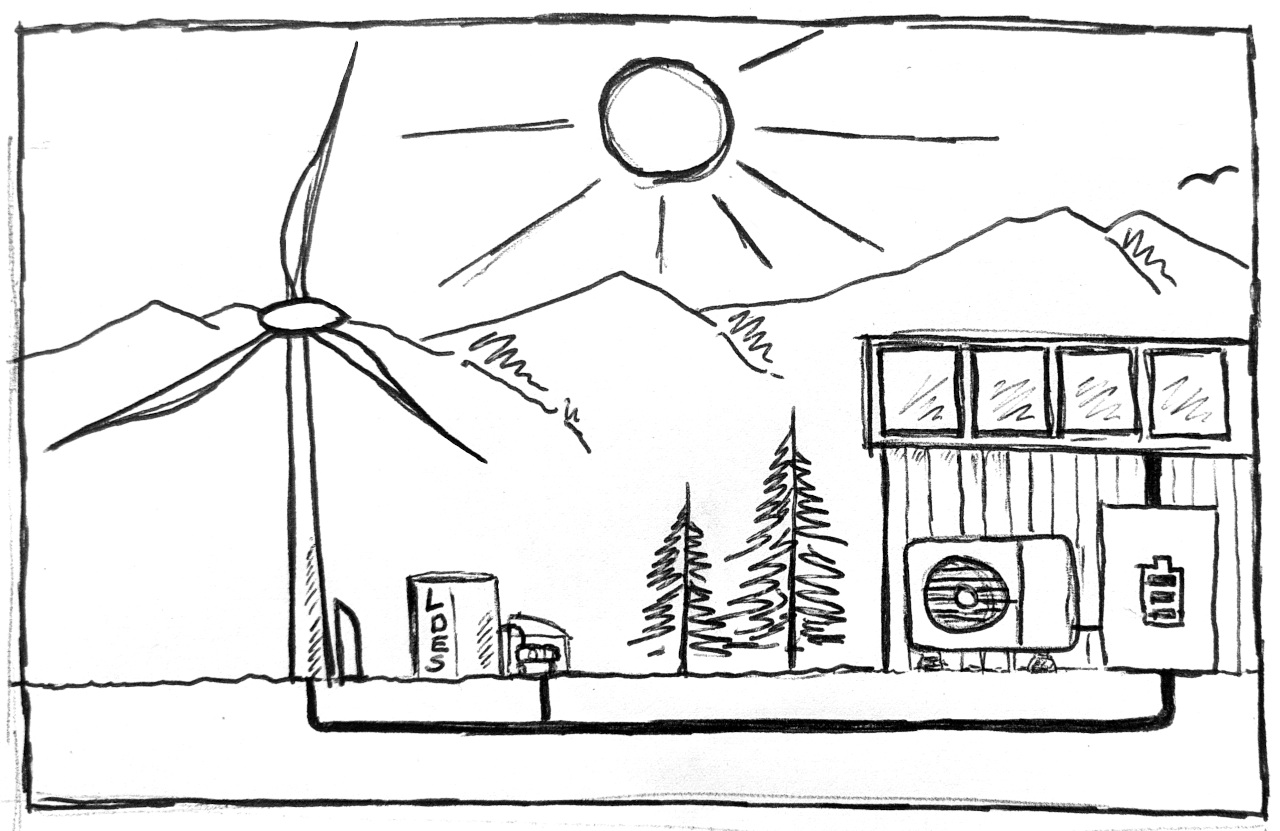
Example 1: Imagine an off-grid house, the heating demand for this house is 9200 kWh/year (6800 kWh/year of space heating and 2400 kWh/year of hot water). The maximum heat demand on the coldest day is 3.3 kW continuous. The annual SCOP/SPF (H4) of the system is 4.1 resulting in an electricity demand of 2240 kWh/year. This house has also got 1800 kWh/year of lighting, appliances and induction/electric cooking demand resulting in a total electric demand of 4040 kWh/year.
Solar + storage
If we start by looking at the lighting, appliances and cooking demand in isolation. 1800 kWh/year would on the face of it require 2.1 kW of solar. Without a battery this would match only about 30% of the demand directly, with a 10 kWh battery 2.1 kW of solar would meet 61% of demand. This simple system would provide ample power from April through to September but then provide very little power through the winter.
To increase the amount of demand met by the solar + storage system we can either increase the size of the solar array and throw away excess power when we cant use it or increase the size of the battery so that we can store more solar electricity or both. If we double the size of the solar array to 4.2 kW. The solar array would now meet 36% of demand before the battery and 74% of demand after a 10 kWh battery. Increasing the size of the battery to 20 kWh only increases matching to 75%. We would actually need a 550 kWh battery to cover all of our lighting, appliances and cooking electricity demand even with a solar array that generates twice as much electricity as we need. If we double the size of the solar array again to 8.4 kW, this would reduce the size of the battery required to 350 kWh.
Lets now introduce the heat pump. Total annual electricity demand is now 4040 kWh/year but demand is now heavily weighted to the winter. On the face of it we could generate this amount of electricity with 4.8 kW of solar which might easily fit on the roof of the house (850 kWh/kWp in the North Wales, UK). Without a battery this would match only about 28% of the demand directly, with a 10 kWh battery 4.8 kW of solar would meet 48% of demand. This simple system would provide ample power from mid April through to mid September but again provide very little power through the winter.
If we double the size of the solar array to 10 kW, direct matching rises to 34% and matching after the battery to 60%. A 60kWh battery would only increase matching to 62%. We would need a 1800 kWh battery to cover all of the demand even with a solar array that generates twice as much electricity as we need. If we quadrouple the solar array to 20 kW we could reduce the size of the battery to 1250 kWh.
As we can see we would need to install pretty heroic levels of solar + battery storage to meet demand throughout the year in the UK climate to be truely off-grid. Automotive pack level battery costs are currently around £80/kWh, with no other costs included this would suggest a battery cost of £144,000! 10 kWh household batteries are currently about £260/kWh for the hardware and perhaps ~£400/kWh installed.
Solar farm cost are about £750/kW, and commercial scale batteries perhaps around £150. The cost balance is probably somewhere around 5x kWh battery per kW of solar. So 80 kW solar and 400 kWh of battery. Total cost of £120,000. Or £1.50/kWh over 20 years or 74p/kWh over 40 years.